Neural networks can create a personalized meal plan based on your budget, season, and available products — if used correctly. Working prompts and a breakdown of limitations.
Social media is currently full of prompts for ChatGPT and Gemini acting as AI nutritionists: “analyze my photo and create a meal plan.” It looks impressive: the neural network spits out a nice board with body-fat percentage, metabolic type, lactose intolerance diagnosis, and a list of “superfoods.” In reality this is quackery. No model can determine body fat, metabolic rate or lactose intolerance from a photo of a face or body; all recommendations are built on thin air. Besides, the food choices that are usually suggested are questionable for Russian latitudes—we rarely base a diet on salmon, avocado and chia seeds; people here are more likely to reach for chicken breast, buckwheat and seasonal vegetables.
The idea of using an AI to build a meal plan is viable—if done correctly. The neural network can compile a personalized meal plan from real data that you upload—quickly, for free, and you can rebuild it at any moment.
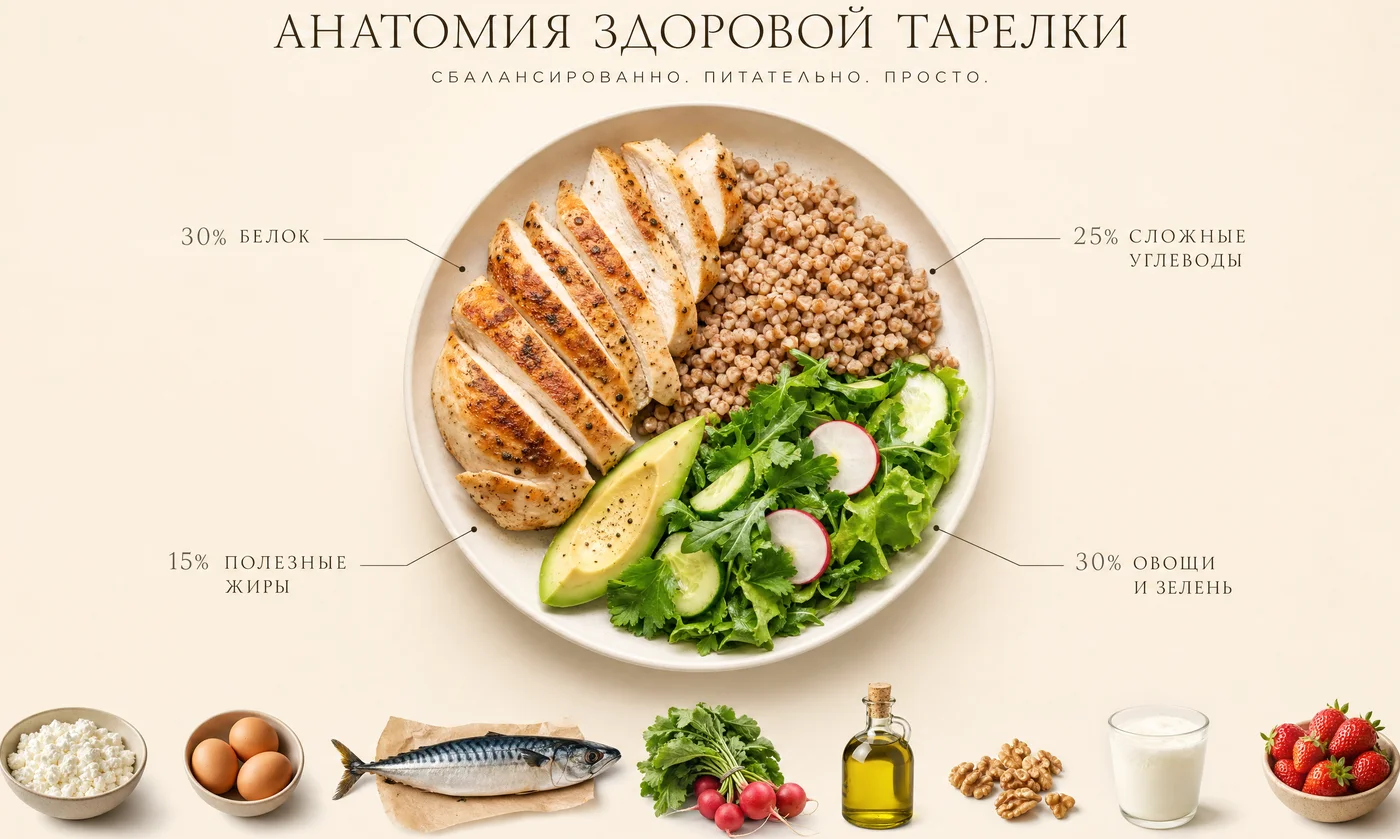
How to create a meal plan with a neural network
The approach works and suits most people who want to fix their diet: eat more varied food, maintain a healthy weight, avoid overspending, and spend less time cooking. Basic parameters, a description of your lifestyle and what’s actually available in stores are enough. The neural network will tailor a plan to your budget, time, season and region.
What to give the neural network
- Age, sex, height, weight
- Activity level: sedentary, standing, physical work
- Training: type and how many times a week
- Goal: weight, energy, muscle, variety
- Weekly food budget
- City or region
- Foods you like and dislike
- How much time you have for cooking
- Where you usually eat: at home, in cafés
Breaking it down with an example
Here’s how it works with an example. Our hypothetical heroine: Svetlana, 35, height 165 cm, weight 62 kg (normal for her height), sedentary office job. Gym twice a week, group classes. Food budget 8,000 rubles per week for one person. Lives in Samara. Cooks 30 minutes a day, takes lunch to work. Feels her current diet isn’t working for her but doesn’t want to dig into medical tests.
Svetlana’s goal: maintain weight, diversify her diet (tired of cooking the same things), spend less time and money on food, feel more energetic in the afternoon.
Below are three prompts you can use one after another: habit analysis, weekly product mood board, ready-made menu. You can copy them and insert your own data.
Analyzing eating habits
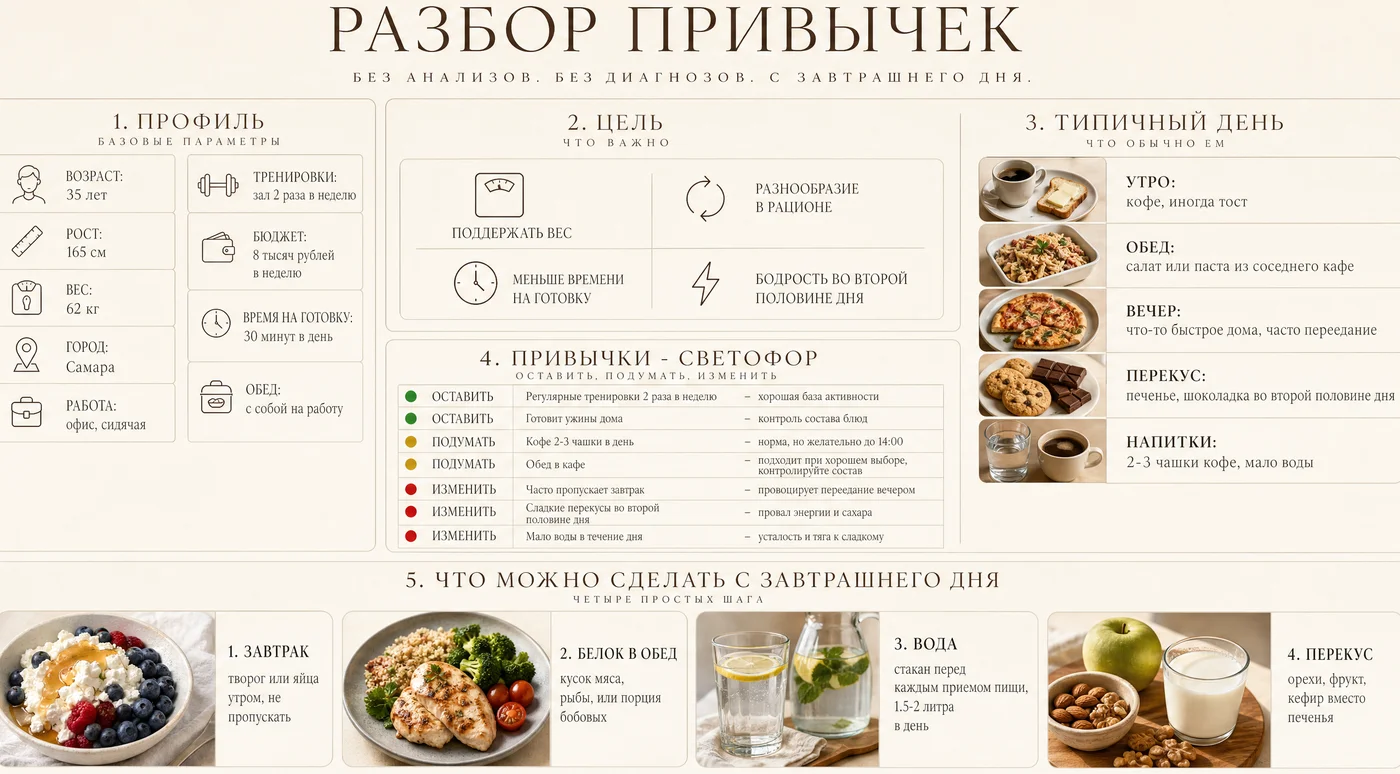
The first step is to understand what already works in your diet and what drains energy and time. The AI takes a description of your typical day and gives structured feedback—without diagnoses or made-up deficiencies.
"Help me understand my eating habits. I need sensible advice based on what I tell you—no tests or lab results.
My details:
- age, sex, height, weight: [fill in]
- city or region: [fill in]
- work: [sedentary, standing, physical], hours per day
- training: [type, times per week]
- sleep: [hours, bedtime]
- what I eat on a normal day: [describe typical breakfast, lunch, dinner, snacks, drinks]
- foods I avoid for principled reasons or because of intolerance
- weekly food budget: [amount]
- minutes per day I’m willing to spend cooking
- where I usually eat: [home, packed lunch at work, cafeteria, ordering in]
Goal: [what I want to improve—weight, muscle, energy, variety, time savings]
Do the following.
First. Briefly describe my current diet overall: what’s strong, what’s weak, what’s missing for my goal.
Second. Rate my current habits with a traffic-light system:
- KEEP: works for the goal, maintain
- CONSIDER: neutral or context-dependent
- CHANGE: works against the goal, adjust
Third. Give 3–4 practical tips I can apply starting tomorrow. No diets, no strict restrictions, no promises.
Fourth. Tell me which foods to focus on based on my goal, budget, city and season. Remember I live in [city] and can only buy what’s in my stores. It’s currently [season].
Don’t invent a body-fat percentage, don’t diagnose anything, don’t prescribe supplements. If something looks off and tests are needed, list them without pressure."
You’ll receive structured feedback on your usual diet: the AI can notice and point out that you often skip breakfast and overeat in the evening, your lunch lacks protein and is heavy on fast carbs, or you crave sweets in the afternoon because of low energy. These gaps can be fixed with food—no hunger required.
Weekly product mood board within budget
The second step: get a clear list of what to buy each week. This is a realistic basket matched to your budget, a ready base for a menu, and it cuts the time spent wondering “what should I cook?”
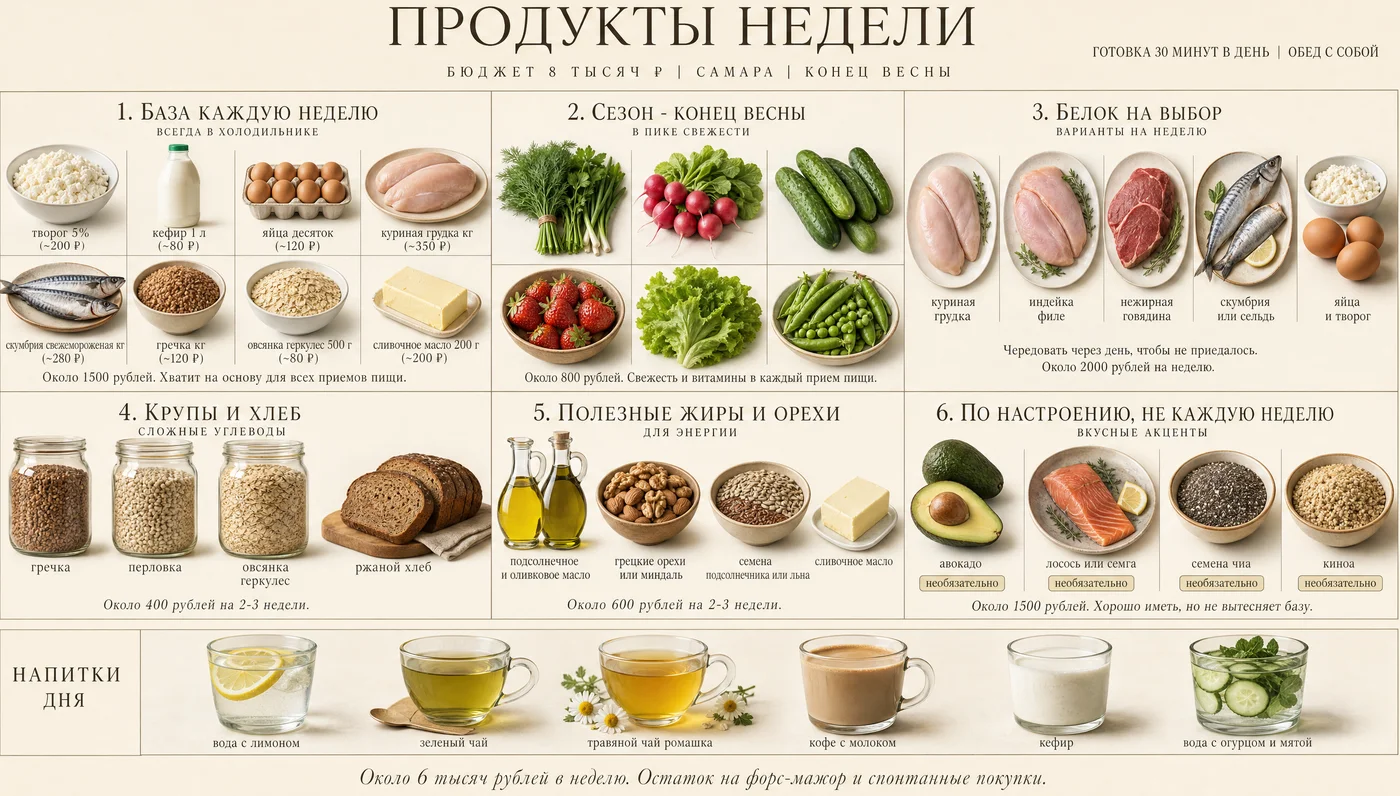
"Based on the analysis of my habits, create a visual weekly product mood board. Not a general guide, but a concrete basket matched to my budget, my city and my lifestyle.
Style: clean editorial presentation with photorealistic product images. Warm cream background, minimalist fonts, grid layout.
Include the following blocks.
Weekly staples: 8–10 products we keep at home all the time—realistically available in my stores [city], reasonably priced and won’t spoil in 3–4 days.
Seasonal highlights: 4–5 products currently in season in my region that add freshness to the diet. It’s currently [season].
Protein sources: 4–5 options that fit my budget. Russian, accessible. Chicken, turkey, beef, fish (which varieties are actually available), cottage cheese, eggs.
Complex carbs: 3–4 grains or cereals. Buckwheat, oats, pearl barley, brown rice.
Healthy fats: 3–4 sources. Vegetable oils, nuts, seeds, fatty fish.
Things to buy only when you feel like it, not as staples: avocado, salmon, chia, quinoa and other trendy “superfoods.” Optional, not essential.
Drinks: 4–5 options suited to my goal—water, herbal teas, coffee, kefir.
Under each group note the approximate cost in rubles so I know how it fits my budget.
All products must be real—no Instagram-wellness styling. Just an ordinary grocery-store basket."
The output is a clear map of weekly purchases: 10 staple products, seasonal additions, and concrete price benchmarks. This removes half the morning pondering before heading to the store.
Weekly menu from available products
The third step: get a ready-made menu that takes your budget, cooking time, habits and eating format (lunch at work, dinner at home, etc.) into account. Not a rigid day-by-day schedule, but a builder of options so you can assemble each day yourself.
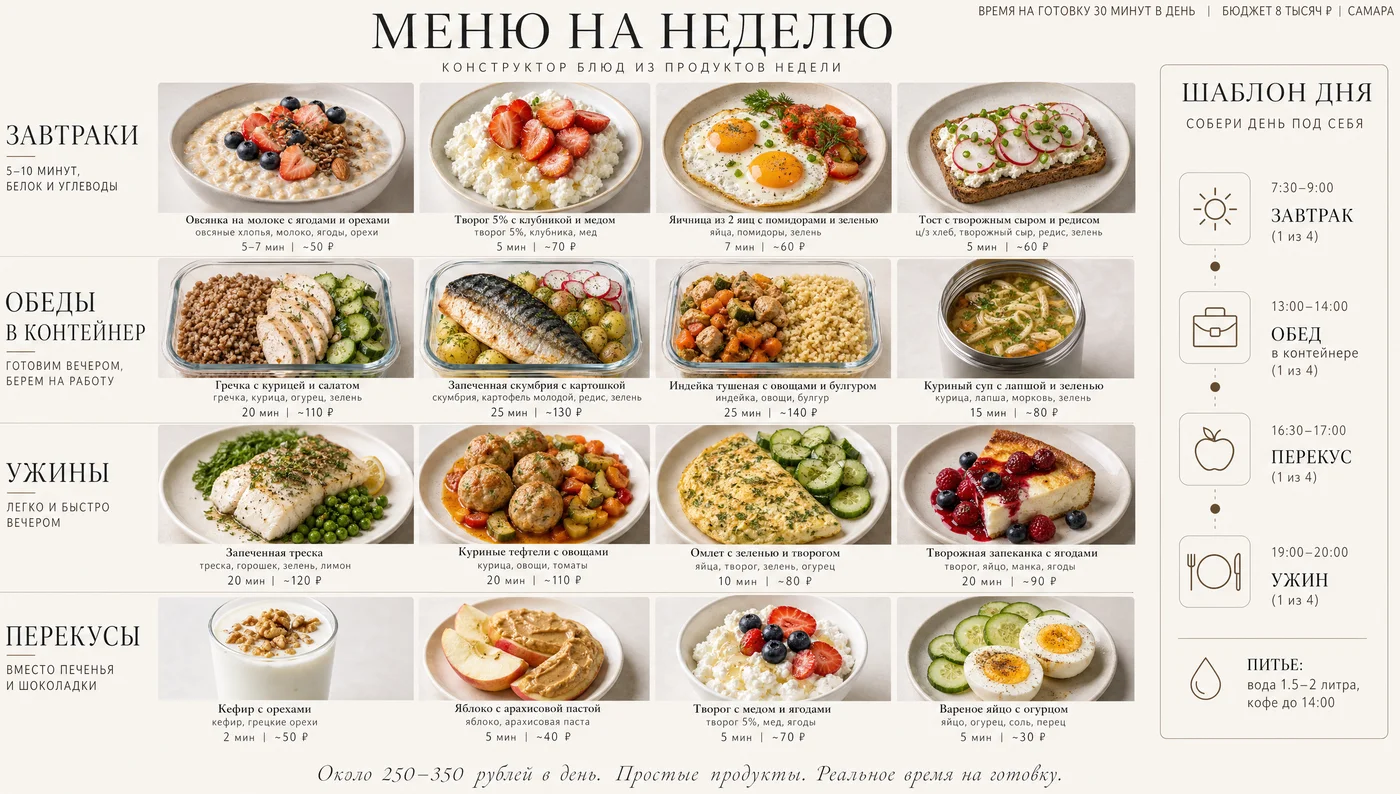
"Based on my analysis and the product mood board, create a weekly menu for me. Not a rigid schedule, but a builder: 4–5 breakfast options, 4–5 lunch options, 4–5 dinner options and 3–4 snack options. I’ll assemble each day according to my mood and schedule.
For each dish specify:
- ingredients and approximate proportions (use ordinary household measures, no precise grams)
- rough calories and macronutrients for monitoring
- preparation time (important—max 30 minutes a day)
- approximate cost per serving in rubles so I can see if it fits my budget
Follow these principles:
- base: products from the mood board that are actually available in my city’s stores
- dishes are simple to prepare, no rare ingredients
- lunch should work in a container: easy to take to work
- dinner slightly lighter than lunch so it doesn’t interfere with sleep
- no strict bans or detoxes
- variety matters more than perfect composition: a diet of 20 repeating dishes is better than 5 perfect ones
End with a short list of what to buy at the weekend for the following week and roughly how much it will cost. This becomes my shopping template."
You’ll receive a ready menu with a dish builder calculated for your budget and time. You can then rebuild the menu as often as you like—taking a new season or boredom into account, or if you want more protein or more sweets.
Sample menu based on Russian products and season
Breakfasts
- Oatmeal with milk, berries and a handful of nuts
- 5 % cottage cheese with fresh strawberries and honey
- Two-egg scramble with tomatoes, cucumbers and herbs
- Whole-grain toast with cream cheese, radish and parsley
- Cottage-cheese pancakes with a spoonful of sour cream and berries
Lunches
- Buckwheat with braised chicken liver and cucumber-herb salad
- Baked mackerel with jacket potatoes and radish
- Chicken breast with bulgur<|eos|>